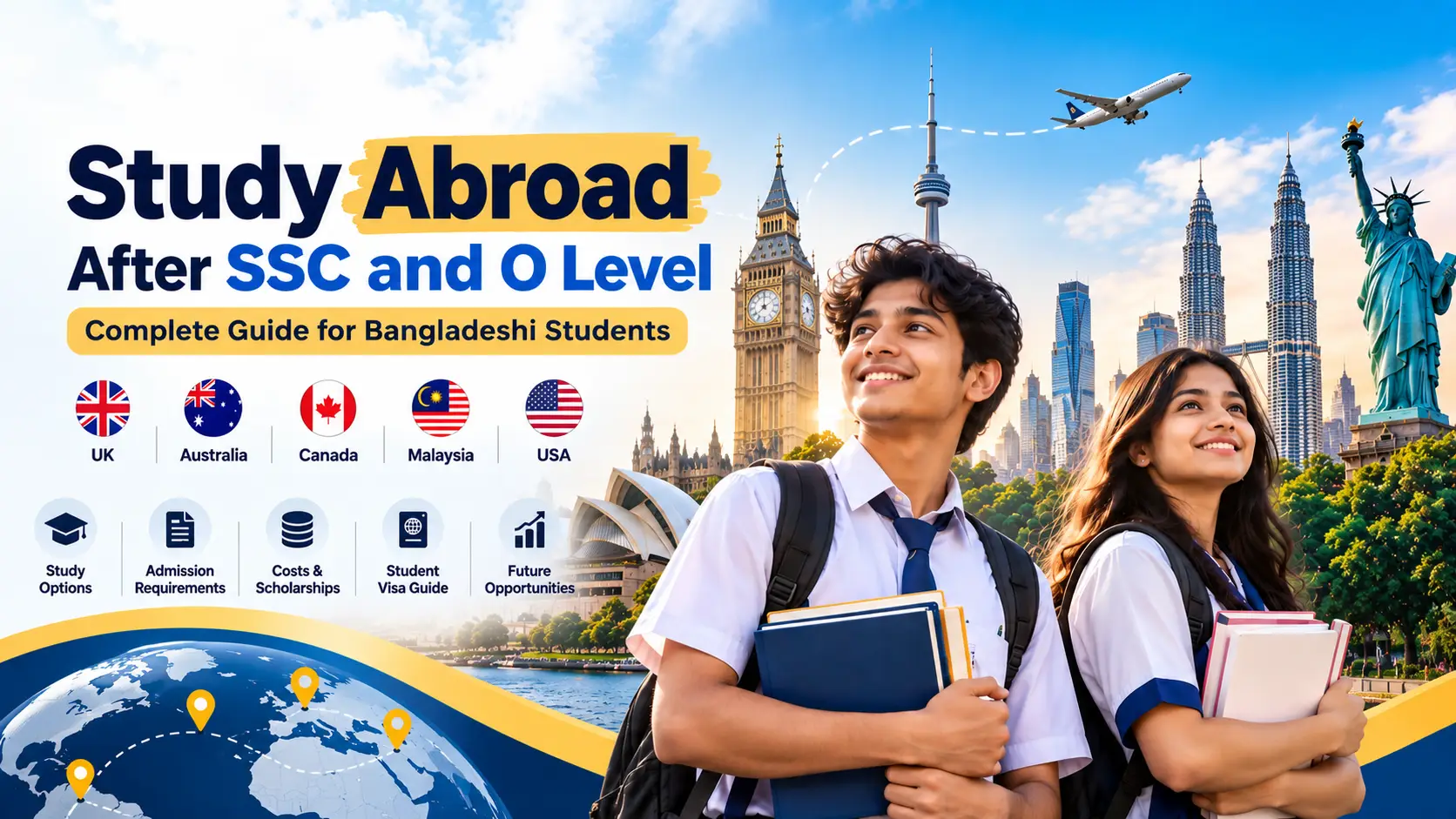
Study Abroad After SSC and O Level: Complete Guide for Bangladeshi Students
Studying abroad is a dream for many Bangladeshi students who want to experience international education, explore new cultures, and prepare for future career opportunities. While most students consider overseas education after completing their Higher Secondary Certificate (HSC) or A Levels, studying abroad after SSC and O Level is also possible through suitable academic pathways.
If you have recently completed your Secondary School Certificate (SSC) or O Level examinations, you may be wondering whether you can continue your education in countries such as the United Kingdom, Australia, Canada, Malaysia, or the United States.
The good news is that several countries offer educational pathways for international students who have completed secondary education. Depending on your age, academic qualifications, English proficiency, and chosen institution, you may be eligible for A Level programmes, senior secondary education, foundation preparation, or certain diploma pathways.
However, completing SSC or O Level does not automatically qualify you for direct admission to an international bachelor's degree. Most universities require a qualification equivalent to 12 or 13 years of schooling, depending on the education system.
This comprehensive guide from NWC Education explains how to study abroad after SSC and O Level from Bangladesh, including available countries, academic pathways, admission requirements, tuition fees, scholarships, visa considerations, and application procedures.
Can You Study Abroad After SSC or O Level from Bangladesh?
Yes, Bangladeshi students can study abroad after completing SSC or O Level, provided they meet the admission and immigration requirements of their chosen country and institution.
In Bangladesh, SSC is generally completed after Class 10, while O Level is an internationally recognised secondary qualification typically taken at a similar educational stage.
Although both qualifications can provide a foundation for further education, they are not necessarily considered equivalent for every overseas admission pathway.
Students who have completed SSC or O Level can explore several options:
A Level programmes at international schools or colleges
International Baccalaureate (IB) Diploma Programme
Senior secondary or high school programmes
Approved university foundation or pre-university courses
Selected vocational or diploma programmes, where eligible
International academic preparation programmes
The most suitable option depends on the student's educational background, age, financial circumstances, preferred destination, and long-term academic goals.
For example, a student planning to pursue a bachelor's degree in the UK might complete A Levels or an eligible foundation programme before entering university.
Similarly, a student interested in studying in Canada may need to complete the remaining years of secondary school before qualifying for undergraduate admission.
Understanding these differences is essential before submitting an application.
Why Consider Studying Abroad After SSC and O Level?
Starting international education at an earlier stage can provide valuable academic and personal development opportunities.
1. Early Exposure to International Education
Studying overseas allows students to become familiar with a different education system, teaching methods, and academic expectations.
International schools and colleges may emphasise independent learning, research, presentations, practical assignments, and critical thinking.
This experience can help students prepare for university-level education.
2. Improved English Communication Skills
Living and studying in an English-speaking academic environment can help students develop their language abilities through everyday communication, classroom participation, and academic activities.
Strong communication skills can be valuable for future university studies and professional development.
3. Access to International Academic Pathways
Completing a recognised secondary or pre-university qualification abroad may provide access to undergraduate programmes in the same country or other destinations.
However, progression is subject to meeting the admission requirements of the receiving university.
4. Personal Development and Independence
International education encourages students to become more responsible, adaptable, and confident.
Students learn to manage academic responsibilities, communicate with people from different backgrounds, and adjust to unfamiliar environments.
For younger students, appropriate parental support, safeguarding arrangements, and accommodation are particularly important.
5. Preparation for Future Career Opportunities
An international education can help students build knowledge, skills, and cross-cultural experience.
While studying abroad does not guarantee employment or immigration opportunities, it can contribute to long-term academic and professional development.
Best Countries to Study Abroad After SSC and O Level
Several countries provide educational opportunities for students who have completed SSC or O Level in Bangladesh.
However, the available programmes and eligibility criteria vary significantly.
1. Study in the UK After SSC and O Level
The United Kingdom is a popular destination for Bangladeshi students because of its internationally recognised qualifications, established education system, and range of academic pathways.
After completing SSC or O Level, students may consider studying at an eligible UK school or college.
Available study pathways
A Level programmes
International Baccalaureate Diploma
Selected foundation programmes
Further education or vocational qualifications
Other approved pre-university pathways
Can you study in the UK after SSC?
Yes, but the type of programme you can enter depends on your qualifications, age, and the institution's entry requirements.
Students with suitable O Level results may be eligible to apply for A Level courses at participating schools or colleges.
SSC students may also find eligible secondary or preparatory programmes, although institutions may assess Bangladeshi SSC qualifications differently.
Admission requirements
Common requirements may include:
SSC or O Level academic certificates
Academic transcripts or examination results
Evidence of English language ability
Valid passport
Parental consent for applicants under 18
Evidence of financial support
Any institution-specific entrance assessment or interview
Some foundation programmes accept students with qualifications below A Level, but others require completion of Year 11 or Year 12 or an equivalent qualification.
Students should confirm eligibility before applying.
Student visa considerations
Depending on the student's age and educational institution, an eligible applicant may need a Student visa or Child Student visa.
These routes have different sponsorship, age, course, accommodation, and financial requirements.
Not every private school or college can sponsor every type of international student visa.
2. Study in Australia After SSC and O Level
Australia offers internationally recognised secondary education and a range of vocational and university preparation pathways.
Students who complete SSC or O Level may be able to continue their education through an eligible Australian secondary school.
Available study pathways
Year 11 and Year 12 secondary education
Senior secondary certificate programmes
Selected foundation studies
Eligible vocational education and training programmes
Can you study in Australia after SSC?
Yes. Students who have completed Class 10 may be considered for admission into an appropriate secondary school year, subject to academic assessment and age requirements.
Some institutions also offer foundation programmes for international students, although entry requirements vary.
Admission requirements
Students may need:
SSC or O Level certificates and transcripts
English proficiency evidence
Passport
Proof of financial capacity
Overseas Student Health Cover where required
Parental consent and approved welfare arrangements for minors
Confirmation of enrolment from an eligible institution
Students under 18 must meet specific welfare and accommodation requirements.
Australian institutions may assess applicants based on academic performance, English ability, and their previous education system.
3. Study in Canada After SSC and O Level
Canada offers secondary education through public and private schools, subject to provincial regulations and school admission policies.
For Bangladeshi students who have completed SSC or O Level, continuing high school in Canada may be a suitable option.
Available study pathways
Grade 11 and Grade 12
Provincial high school diploma programmes
International Baccalaureate programmes
Other recognised secondary school qualifications
Can you study in Canada after SSC?
Yes. Depending on age, previous studies, and provincial school placement rules, students may be able to enter an appropriate Canadian secondary school grade.
However, admission to a Canadian college or university directly after SSC is generally not the standard pathway.
Most undergraduate institutions require completion of an accepted upper-secondary qualification.
Admission requirements
Common requirements include:
Academic transcripts
SSC or O Level examination results
Passport
School admission letter
Proof of sufficient funds
Custodianship documents where required
English language assessment, if requested
Minor students may need a custodian in Canada, depending on their age and circumstances.
Study permit requirements also depend on the type of institution and programme.
4. Study in Malaysia After SSC and O Level
Malaysia attracts international students through its diverse education system, international schools, and pre-university opportunities.
Students from Bangladesh may explore suitable secondary or preparatory programmes after completing SSC or O Level.
Available study pathways
A Level programmes
International Baccalaureate programmes
Selected foundation programmes
Eligible diploma programmes
Other recognised pre-university qualifications
Can you study in Malaysia after SSC?
Yes, subject to the admission requirements of the institution.
Some colleges may consider O Level qualifications for foundation or diploma programmes, depending on the number of subjects passed and the required grades.
Bangladeshi SSC qualifications may be assessed separately and are not automatically interchangeable with O Levels.
Admission requirements
Requirements may include:
Academic certificates and transcripts
Proof of English proficiency
Valid passport
Financial documents
Medical screening, where applicable
Parent or guardian documentation for minors
Relevant student pass approval
Before enrolling, students should confirm that the institution and programme are properly recognised and eligible to admit international students.
5. Study in the USA After SSC and O Level
The United States provides various educational opportunities through public and private secondary schools, as well as recognised international academic programmes.
Students who have completed SSC or O Level may consider completing their high school education in the USA.
Available study pathways
Grade 11 and Grade 12
Accredited private high school programmes
Eligible international boarding schools
Recognised high school diploma pathways
Can you study in the USA after SSC?
Yes. Eligible students may be admitted to an American secondary school based on their academic records, age, English proficiency, and school requirements.
However, international students must carefully consider the rules governing the type of school they wish to attend.
For example, F-1 students attending public high schools are subject to specific restrictions, including a maximum attendance period and payment requirements.
Private schools may offer different options, subject to their eligibility to enrol international students.
Admission requirements
Common requirements may include:
SSC or O Level academic records
Passport
English proficiency evidence
Financial documentation
Admission to an eligible institution
Form I-20 where required
Parent or guardian arrangements
Appropriate student visa documentation
Students should select institutions that can legally enrol international students under the relevant immigration rules.
Which Course Can You Study Abroad After SSC and O Level?
Choosing the right academic pathway is one of the most important decisions for students planning to study abroad after secondary education.
Different qualifications provide different progression opportunities.
A Level Programmes
A Levels are widely recognised pre-university qualifications, particularly in the United Kingdom and other education systems that follow British academic standards.
Students usually select subjects based on their future degree interests.
For example, students interested in engineering may choose Mathematics, Physics, and other relevant subjects.
A Level programmes commonly take approximately two years to complete.
Students who achieve the required grades may then apply for undergraduate degrees at eligible universities.
International Baccalaureate Diploma Programme
The International Baccalaureate Diploma Programme is a recognised two-year educational programme generally designed for students aged 16 to 19.
It combines subject-based learning with research, critical thinking, and other academic components.
The qualification is accepted by many universities worldwide, although individual admission requirements still apply.
Foundation Programmes
Foundation programmes are designed to prepare students for undergraduate study.
They may include academic subject preparation, English language development, and university-level study skills.
Many programmes take approximately one academic year, although durations vary.
Important: Not every foundation programme accepts students immediately after SSC or O Level.
Some require HSC, A Levels, Year 11, Year 12, or another specified qualification.
Students must also check whether the foundation programme provides progression to their preferred university and degree.
Diploma Programmes
Diploma programmes can provide academic or vocational education in areas such as business, hospitality, computing, and other fields.
Entry requirements vary by country, qualification level, and institution.
Some programmes may be accessible with recognised O Level qualifications, while others require completion of higher secondary education.
Students should verify whether a diploma provides a recognised progression route to further study.
High School or Senior Secondary Education
Completing the remaining years of high school abroad is often one of the clearest pathways for students who have finished Class 10.
This option allows students to earn a recognised upper-secondary qualification before applying for university admission.
The duration depends on the student's age, previous education, and placement assessment.
SSC vs O Level: What Is the Difference for Studying Abroad?
Although SSC and O Level are both secondary-stage qualifications, overseas institutions may assess them differently.
CriteriaSSCO LevelEducation systemBangladesh national curriculumInternational British-style curriculumTypical completion stageClass 10Secondary levelQualification assessmentBased on institutional equivalency rulesBased on recognised O Level subjects and gradesPossible next stepsHigher secondary, school or eligible preparatory pathwayA Levels, IB or eligible preparatory pathwayDirect bachelor's admissionGenerally insufficient aloneGenerally insufficient alone
Neither qualification guarantees admission to a particular international programme.
Students should request an individual assessment from the institution before making financial commitments.
Eligibility Requirements to Study Abroad After SSC and O Level
Eligibility requirements depend on the destination, programme, and educational institution.
Nevertheless, most international applications involve several common considerations.
Academic Qualifications
Students generally need to provide proof of completing SSC, O Level, or an equivalent qualification.
Institutions may assess subject grades, overall results, and previous academic performance.
Certain programmes may require specific subjects such as Mathematics, English, or Science.
English Language Proficiency
Students may need to demonstrate sufficient English proficiency to participate in their chosen course.
Depending on the institution and visa rules, acceptable evidence may include:
IELTS or IELTS for UKVI, where required
TOEFL
PTE Academic
An institution-approved English assessment
Other accepted evidence of English language ability
Not all institutions require the same test, and some secondary schools may use their own assessments.
Students should confirm both the admission and immigration requirements.
Age Requirements
Age is particularly important for students applying after SSC or O Level.
Most applicants at this stage are minors.
Different countries may have specific age restrictions for secondary schools, foundation programmes, accommodation, and student visa categories.
Some institutions may not accept students below a particular age.
Financial Requirements
Students and their families must demonstrate that they can afford the relevant educational and living expenses.
These may include:
Tuition fees
Accommodation
Food and transportation
Health insurance
Visa application fees
Travel expenses
Other programme-related costs
Financial evidence requirements differ by destination and visa category.
Parental Consent and Welfare Arrangements
Students under 18 may need written parental consent, an approved guardian or custodian, and suitable accommodation arrangements.
These requirements should be reviewed before applying, not after receiving an admission offer.
Documents Required to Study Abroad After SSC and O Level
Preparing the necessary documents in advance can help students avoid delays.
Commonly requested documents include:
Valid passport
SSC or O Level certificates
Academic transcripts or mark sheets
Previous school records, if requested
English language test results, where required
Completed application form
Personal statement or study plan, if requested
Recommendation letters, if required
Birth certificate or other proof of age
Parent or guardian consent documents
Financial statements and sponsorship evidence
Accommodation, welfare, or custodianship documentation
Additional documents requested by the institution or immigration authority
Some institutions may require certified translations or verification of academic records.
Document requirements should always be confirmed before submission.
How Much Does It Cost to Study Abroad After SSC and O Level?
The total cost of studying abroad depends on the destination, institution, course type, accommodation, and lifestyle.
Secondary schools, boarding schools, foundation colleges, and vocational institutions can have very different fee structures.
The following table provides broad annual planning estimates rather than official quotations.
CountryIndicative annual tuitionLiving and accommodation costsUnited KingdomGBP 10,000–30,000+GBP 10,000–18,000+AustraliaAUD 15,000–35,000+AUD 20,000–35,000+CanadaCAD 12,000–30,000+CAD 15,000–25,000+MalaysiaMYR 15,000–45,000+MYR 12,000–30,000+United StatesUSD 15,000–45,000+USD 12,000–25,000+
These are broad illustrative budgeting ranges for selected international school and preparatory pathways, not verified fees for particular institutions. Boarding school fees may include accommodation and can be substantially higher. Actual costs and immigration financial requirements must be checked individually.
Additional Expenses to Consider
Students should also budget for:
Visa and immigration charges
Health insurance or healthcare-related charges
Flight tickets
School uniforms and learning materials
Examination fees
Accommodation deposits
Guardianship or custodianship services
Personal expenses
Parents should request a complete written fee breakdown before confirming admission.
Are Scholarships Available After SSC and O Level?
Scholarship opportunities may be available for students pursuing international secondary or pre-university education.
However, scholarships for students entering immediately after SSC or O Level are generally more limited than scholarships offered for undergraduate and postgraduate degrees.
Possible scholarship categories include:
Merit-Based Scholarships
Some institutions provide tuition discounts or scholarships to students with strong academic results.
The amount awarded depends on the institution's scholarship policy.
Institution-Specific Scholarships
Certain schools and colleges offer financial assistance to eligible international students.
These opportunities may consider academic performance, extracurricular activities, or other selection criteria.
Need-Based Financial Assistance
A limited number of institutions may offer financial support based on family circumstances.
Students should check eligibility conditions and application deadlines carefully.
Special Achievement Awards
Some schools may consider achievements in sports, leadership, arts, or other activities.
Scholarship availability is not guaranteed, and many awards cover only part of the tuition fees.
Families should avoid assuming that a scholarship will cover all living and educational expenses.
How to Apply to Study Abroad After SSC and O Level from Bangladesh
Applying for international education requires careful planning.
Following a structured process can help students identify suitable programmes and avoid unnecessary complications.
Step 1: Identify Your Academic Goals
Start by considering what you want to study in the future.
For example, if your long-term goal is to study Computer Science, you should investigate which secondary or pre-university subjects are required for relevant degree programmes.
Choosing an appropriate pathway early can help prevent academic progression difficulties later.
Step 2: Choose a Suitable Country
Compare destinations based on:
Education system
Academic pathways
Tuition and living costs
Student safety and welfare
Age requirements
Accommodation options
Visa eligibility
Future university progression
The most popular destination is not necessarily the most suitable option for every student.
Step 3: Select an Institution and Programme
Research schools, colleges, and preparatory institutions that accept your qualification.
Check whether the institution is properly accredited or recognised and whether it is eligible to enrol international students.
Confirm the programme's entry requirements, duration, fees, and progression opportunities.
Step 4: Check Your Eligibility
Review your academic results, age, English proficiency, and financial circumstances.
Students applying immediately after SSC should pay particular attention to qualification equivalency requirements.
Step 5: Prepare Your Documents
Collect academic certificates, transcripts, passport documents, and any additional paperwork required by the institution.
If you are under 18, prepare the necessary parental consent and welfare documents.
Step 6: Submit Your Application
Complete the institution's application form and provide the required supporting documents.
Some schools may arrange an interview or academic assessment.
Step 7: Receive and Review Your Admission Offer
If your application is successful, the institution may issue an admission offer.
Read the conditions carefully, including:
Course commencement date
Tuition and deposit requirements
Refund policy
Academic conditions
Accommodation arrangements
Visa sponsorship eligibility
Do not make non-refundable payments without understanding the relevant terms.
Step 8: Apply for the Appropriate Student Visa
Once you have satisfied the necessary admission conditions, prepare your student visa application.
Requirements vary by country and may include proof of funds, parental consent, health insurance, and approved accommodation arrangements.
An admission offer does not guarantee visa approval.
Step 9: Arrange Accommodation and Travel
After receiving the necessary immigration permission, finalise your accommodation, travel arrangements, and pre-departure preparations.
For minor students, parents should confirm supervision and emergency contact arrangements.
Step 10: Begin Your International Education Journey
Attend orientation, familiarise yourself with the institution's rules, and prepare for your new academic environment.
Maintaining regular communication with family and school support staff can help students adjust successfully.
Should You Study Abroad After SSC or Wait Until HSC?
This is one of the most important questions for Bangladeshi students and their families.
Both options can be appropriate, depending on the student's goals and circumstances.
Studying Abroad After SSC
Potential advantages
Earlier exposure to an international education system
Opportunity to complete secondary or pre-university qualifications abroad
More time to adapt before starting a bachelor's degree
Access to certain international school pathways
Potential challenges
Higher overall education costs
Additional welfare requirements for minors
Longer period of living away from family
Limited eligibility for some programmes
Need for careful planning of university progression
Studying Abroad After HSC
Potential advantages
Wider access to undergraduate degree programmes
Greater academic maturity
Fewer minor-student welfare complications for students who are adults
Potentially lower total costs than completing secondary school overseas
Potential challenges
Students may need to adjust to a new academic environment at university level
Some courses have demanding subject-specific requirements
English proficiency and university admission criteria still apply
Which Option Is Better?
There is no single answer for every student.
Studying abroad after SSC may be suitable for students who have strong family support, sufficient financial resources, and a clear academic plan.
Completing HSC or A Levels in Bangladesh before applying abroad may be a more practical and affordable option for other students.
Students should evaluate the long-term benefits and costs before deciding.
Common Mistakes to Avoid When Planning to Study Abroad After SSC
International education is a significant financial and academic commitment.
Avoiding common mistakes can help students and parents make better decisions.
Assuming SSC Guarantees University Admission
SSC is a secondary-level qualification and generally does not satisfy the direct entry requirements for an international bachelor's degree.
Students should understand the difference between secondary education, foundation programmes, and undergraduate degrees.
Choosing a Programme Without Checking Progression
Not every foundation or diploma qualification provides admission to every university.
Before enrolling, confirm which institutions and degree programmes recognise the qualification.
Ignoring Age and Welfare Requirements
Minor students may need approved accommodation, guardianship, or custodianship arrangements.
Failing to meet these requirements can affect admission or visa eligibility.
Underestimating Total Costs
Tuition fees are only one part of the total expense.
Families should prepare a realistic budget covering accommodation, insurance, transportation, and additional educational costs.
Relying on Unverified Admission Promises
Students should verify institution recognition, programme eligibility, and immigration requirements.
No education consultancy or institution can guarantee a student visa.
Applying Too Late
Application deadlines, school start dates, visa processing periods, and accommodation availability can affect the intended intake.
Starting preparation early allows more time to address unexpected requirements.
How NWC Education Can Help You Study Abroad After SSC and O Level
Planning international education immediately after secondary school can be complicated, especially when different countries have different qualification and age requirements.
At NWC Education, we understand that every student's academic journey is different.
Our experienced education counsellors help students and families explore suitable international study opportunities based on academic qualifications, personal goals, and financial considerations.
Personalised Academic Assessment
We help students understand how their qualifications may relate to international admission pathways and identify areas that require further verification.
Country and Course Guidance
Our counsellors help students compare destinations and explore programmes that align with their academic ambitions.
Institution Selection
We assist students in researching suitable institutions, admission criteria, and potential progression routes.
Application Assistance
Our team provides guidance on preparing application documents and completing relevant admission procedures.
Visa Preparation Guidance
We help students and families understand the documentation and preparation involved in student visa applications, including considerations for applicants under 18.
Pre-Departure Support
We provide guidance to help students prepare for the transition to international education, including practical considerations before travelling.
Whether you are interested in studying in the UK, Australia, Canada, Malaysia, or another destination, NWC Education can help you explore your options and plan your next academic steps.
All admissions and immigration decisions remain subject to the relevant institution and authorities.
Frequently Asked Questions About Studying Abroad After SSC and O Level
1. Can I study abroad after SSC from Bangladesh?
Yes. Bangladeshi students can apply for eligible secondary school, A Level, IB, or selected preparatory programmes abroad after SSC. Admission depends on the institution, country, age, and academic qualifications.
2. Can I go to the UK after SSC?
Yes. Students may be eligible for appropriate school, college, or pre-university pathways in the UK. The institution must accept the student's qualifications and meet the relevant visa sponsorship requirements.
3. Can I study abroad after O Level without A Levels?
Yes, certain international schools and preparatory institutions offer pathways for eligible O Level students. However, many bachelor's degree programmes require A Levels or another recognised upper-secondary qualification.
4. Which country is best for studying abroad after SSC?
The best destination depends on academic goals, financial resources, programme availability, age requirements, and family preferences. The UK, Australia, Canada, Malaysia, and the USA offer different secondary and preparatory education opportunities.
5. Can I get a scholarship after SSC?
Some international schools and colleges offer merit-based scholarships or tuition discounts. Availability and eligibility vary, and full scholarships at this stage are relatively limited.
6. Is IELTS compulsory for studying abroad after SSC?
Not always. Some institutions accept alternative evidence of English proficiency or conduct their own assessments. However, English language and visa requirements vary by country and programme.
7. Can I apply for a bachelor's degree directly after SSC?
Generally, SSC alone is not sufficient for direct admission to a bachelor's degree abroad. Most universities require a recognised higher secondary qualification or completion of an eligible preparatory pathway.
8. Can I study in Canada after SSC?
Yes. Students may be eligible to continue secondary education in Canada, subject to school placement, admission requirements, study permit rules, and custodianship requirements where applicable.
9. How long does it take to complete a foundation programme?
Many foundation programmes last approximately one academic year. However, the duration and entry requirements differ, and not all foundation courses accept students directly after SSC or O Level.
10. Is studying abroad after SSC better than studying after HSC?
It depends on the student's circumstances. Studying abroad after SSC provides earlier international exposure, while completing HSC in Bangladesh may offer a more affordable pathway to undergraduate admission.
11. Can students under 18 apply to study abroad?
Yes, subject to the rules of the destination country and institution. Students under 18 may require parental consent, approved accommodation, guardianship or custodianship arrangements, and other welfare documentation.
12. How can NWC Education help students after SSC and O Level?
NWC Education provides guidance on academic pathways, destination selection, institution research, admission requirements, application preparation, and study abroad planning.
Final Thoughts
Studying abroad after SSC and O Level can be an exciting opportunity for Bangladeshi students who want to begin their international education journey at an early stage.
However, success depends on selecting an appropriate academic pathway, understanding qualification requirements, planning finances, and meeting the relevant admission and immigration conditions.
Students should remember that completing SSC or O Level is generally the beginning of a pre-university journey rather than a direct route into an international bachelor's degree.
Whether you choose A Levels, an International Baccalaureate programme, senior secondary education, or an eligible foundation pathway, the right decision should support your long-term academic goals.
With proper preparation and reliable guidance, students and families can make informed decisions about international education.
Start Your Study Abroad Journey with NWC Education
Have you recently completed SSC or O Level and want to explore your international education options?
NWC Education can help you understand suitable study pathways, compare destinations, and prepare for the next stage of your academic journey.
Book a free consultation with NWC Education today and take the first step towards your international education goals.