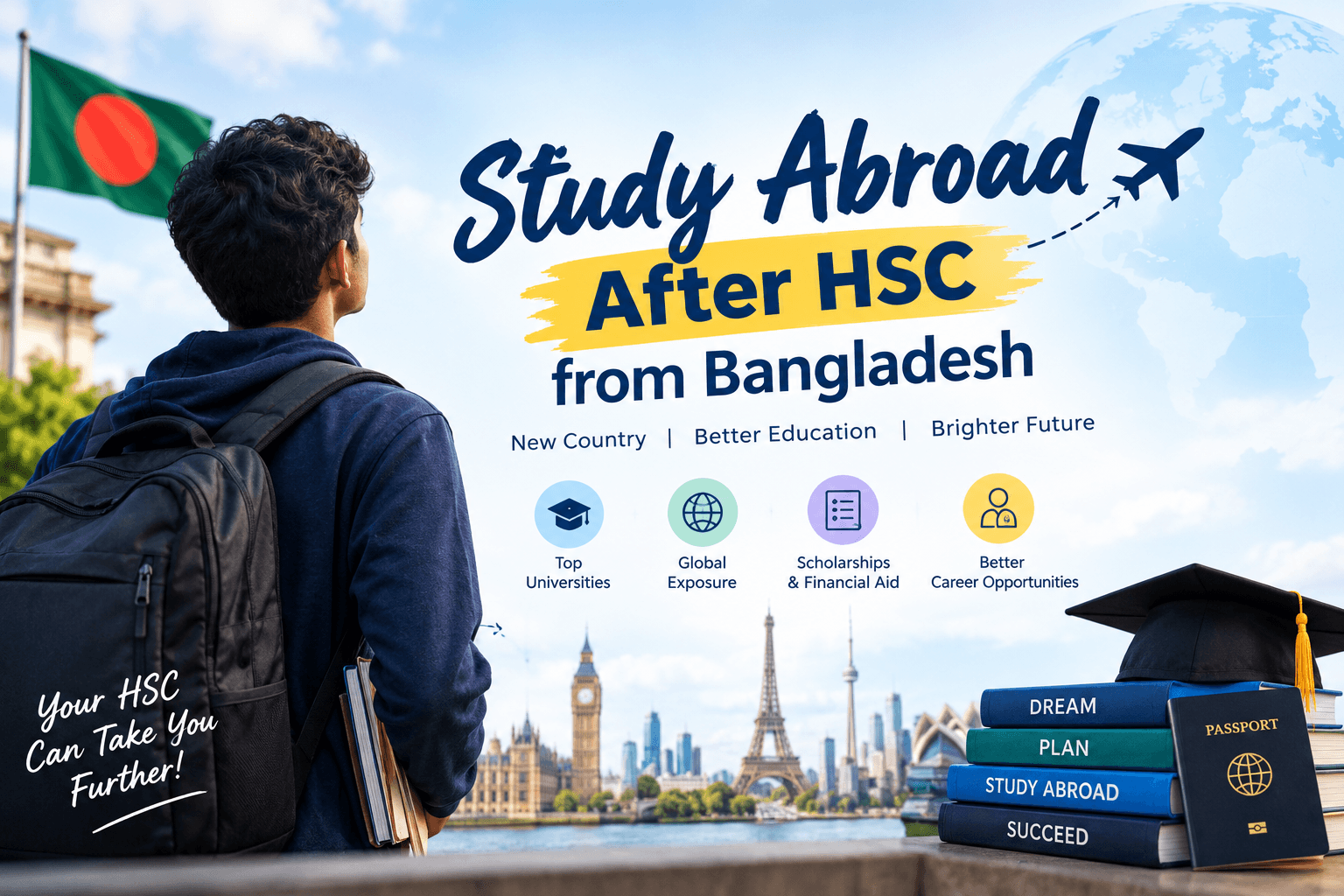
Top 10 Best Countries to Study Abroad for International Students
Choosing the right country for higher education is an important decision for international students. The right destination depends on several factors, including university quality, available courses, tuition fees, living costs, scholarships, student visa rules, work opportunities and future career plans.
Countries such as the UK, USA, Canada, Australia, Germany, New Zealand, the Netherlands, Sweden, Finland and Denmark offer different advantages for international students. Instead of choosing a destination based only on rankings, students should compare the country, university and specific programme that best match their academic and financial goals.
What to Consider When Choosing a Study Abroad Destination
Before applying to a university overseas, consider:
Quality and recognition of universities
Availability of your preferred subject
Tuition fees and living costs
Scholarship opportunities
English-taught programmes
Student visa requirements
Permitted work during studies
Graduate work opportunities
Accommodation and lifestyle
Long-term career plans
The most suitable country can be different for every student. A destination with lower tuition fees may not necessarily have the right programme, while a country with higher tuition fees may offer a programme that better matches your career plans.
1. United Kingdom
The United Kingdom remains a major destination for international students because of its internationally recognised universities, broad subject choices and established higher education system.
Universities such as the University of Oxford, University of Cambridge, Imperial College London, University College London and the London School of Economics and Political Science are internationally recognised, while many other UK universities offer a wide range of undergraduate and postgraduate programmes.
The UK is particularly popular for Business, Computer Science, Engineering, Law, Finance, Medicine, Data Science and Social Sciences.
One of the attractions of UK higher education is the availability of relatively short degree programmes. Many bachelor's degrees can be completed in three years in England, Wales and Northern Ireland, while many master's programmes can be completed in one year.
Studying in the UK
International students can choose from thousands of programmes across universities and colleges. Many courses also include opportunities for internships, placements or industry experience.
For most eligible Student visa students, work is permitted for up to 20 hours per week during term time, although the exact conditions depend on the course and visa.
Eligible graduates can also use the UK's Graduate Route to remain in the country after completing an eligible course and look for work or work without requiring employer sponsorship under that route. Current rules should always be checked before applying.
2. United States
The United States has one of the world's largest higher education systems, with universities and colleges offering programmes across almost every academic discipline.
Universities such as MIT, Stanford University, Harvard University, Princeton University and the University of California, Berkeley are well known internationally. The country also has many public universities and other institutions offering programmes across different budgets and academic interests.
The USA can be particularly attractive for students interested in:
Computer Science
Artificial Intelligence
Engineering
Business and Finance
Data Science
Biotechnology
Medicine and Life Sciences
Media and Communication
Studying in the USA
One advantage of the US education system is the variety of programmes and academic pathways available. Depending on the institution and degree, students may also have flexibility in selecting courses and developing an academic specialisation.
International students commonly study under the F-1 student visa category at accredited colleges and universities. Other student visa categories include J-1 for exchange programmes and M-1 for vocational or non-academic study.
Students considering employment after graduation should research the relevant employment authorisation rules, including Optional Practical Training where applicable, because work eligibility depends on immigration status, programme and other conditions.
3. Canada
Canada is another popular destination for international students, offering universities, colleges and specialised institutions across a wide range of subjects.
Some internationally recognised universities include the University of Toronto, McGill University, University of British Columbia, University of Alberta and McMaster University.
Popular study areas include:
Computer Science and IT
Engineering
Business
Data Science
Artificial Intelligence
Health Sciences
Environmental Studies
Hospitality and Tourism
Studying in Canada
Most international students studying programmes longer than six months need a Canadian study permit and generally need a letter of acceptance from a designated learning institution. Applicants must also demonstrate that they can cover tuition, living expenses and transportation costs, along with meeting other eligibility requirements.
Canada's international student system has undergone several policy changes in recent years, including limits on study permit processing and changes to eligibility requirements. Students should therefore check the latest IRCC rules before applying.
After graduation, some students may be eligible for a Post-Graduation Work Permit, depending on the programme, institution and current immigration rules.
4. Australia
Australia has a large international education sector and is home to universities recognised internationally for teaching and research.
The University of Melbourne, Australian National University, University of Sydney, Monash University and the University of Queensland are among the country's well-known universities.
Popular subjects for international students include:
Engineering
Computer Science
Information Technology
Business
Accounting and Finance
Data Science
Health Sciences
Environmental Science
Cybersecurity
Studying in Australia
Australia offers a multicultural environment and a wide selection of undergraduate and postgraduate programmes.
International students can generally work while studying, subject to their visa conditions. The current work-hour cap during study periods is 48 hours per fortnight.
Students should also consider Australia's relatively high living costs when preparing their financial plan. Scholarships are available through universities and government-supported programmes, but eligibility varies.
5. Germany
Germany is particularly attractive to students interested in engineering, technology, research and science. The country has a large higher education system that includes research universities, universities of applied sciences and other institutions.
Well-known universities include Technical University of Munich, LMU Munich, Heidelberg University, RWTH Aachen University and Karlsruhe Institute of Technology.
Popular fields include:
Mechanical Engineering
Electrical Engineering
Computer Science
Automotive Engineering
Renewable Energy
Data Science
Business
Natural Sciences
Studying in Germany
One major attraction is the relatively low tuition cost at many public higher education institutions. DAAD states that there are generally no tuition fees for bachelor's programmes and many master's programmes at state higher education institutions, although there are important exceptions. For example, Baden-Württemberg charges tuition for many non-EU students, and some institutions in Bavaria may also charge tuition. Students must check the exact rules for their chosen programme.
International students can also work subject to German immigration rules. The applicable working-day rules for non-EU students have changed, so applicants should check current requirements before planning employment during their studies.
Germany can be especially suitable for students who want to combine internationally recognised education with strong links to engineering, technology and industry.
6. New Zealand
New Zealand offers a smaller but internationally recognised higher education system and is known for its universities, practical learning environment and international student community.
Popular universities include the University of Auckland, University of Otago, Victoria University of Wellington, University of Canterbury and Massey University.
Students can explore subjects such as:
Business
Engineering
Computer Science
Information Technology
Agriculture
Environmental Science
Hospitality
Health Sciences
Studying in New Zealand
New Zealand offers a supportive environment for international students and provides opportunities to gain academic and practical experience.
Many eligible international students can work up to 20 hours per week during the academic year and full-time during scheduled holidays, depending on their visa conditions.
The country also offers post-study work pathways for eligible graduates. The exact length and eligibility depend on the qualification and current immigration rules.
7. Netherlands
The Netherlands is an increasingly popular European destination for international students because of its large selection of English-taught programmes and internationally oriented education system.
Universities such as Delft University of Technology, University of Amsterdam, Leiden University, Utrecht University and Erasmus University Rotterdam are known internationally.
Popular study areas include:
Engineering
Computer Science
Business
Economics
Data Science
Artificial Intelligence
Environmental Studies
Social Sciences
Communication and Media
Studying in the Netherlands
The official Study in NL database provides an up-to-date overview of English-taught programmes in the Netherlands, covering bachelor's, master's and other study options.
Admission requirements are determined by the individual institution and can vary between programmes. English-taught programmes generally require proof of English proficiency through an accepted test or another recognised form of evidence.
Non-EEA graduates who meet the applicable conditions may also be able to apply for an orientation year residence permit after graduation to look for work or start a business.
8. Sweden
Sweden is well known for research, innovation, sustainability and technology. It offers a number of English-taught programmes, particularly at master's level.
Popular universities include Lund University, Uppsala University, KTH Royal Institute of Technology, Stockholm University, Chalmers University of Technology and Linköping University.
International students often consider Sweden for:
Computer Science
Artificial Intelligence
Engineering
Data Science
Business
Renewable Energy
Sustainability
Life Sciences
Design
Studying in Sweden
Swedish universities combine academic study with research and innovation, and many programmes encourage independent learning, critical thinking and practical application.
Students from outside the EU/EEA and Switzerland generally pay tuition fees for eligible programmes unless an exemption applies. Scholarships are available through universities and organisations such as the Swedish Institute, depending on eligibility.
Sweden can be particularly relevant for students interested in technology, sustainability and research-oriented master's programmes.
9. Finland
Finland has a strong reputation for education, research and innovation and offers hundreds of English-taught bachelor's and master's programmes.
Universities such as the University of Helsinki, Aalto University, University of Turku, Tampere University and University of Oulu are among the country's internationally recognised institutions.
Popular fields include:
Computer Science
Artificial Intelligence
Information Technology
Engineering
Data Science
Business
Environmental Science
Biotechnology
Health Sciences
Studying in Finland
Students from outside the EU/EEA and Switzerland generally pay tuition fees for English-taught bachelor's and master's programmes. Current Study in Finland guidance places typical tuition fees at around €9,000 to €20,000 per year, depending on the programme and university.
Universities may offer scholarships or tuition fee waivers, but these are competitive and generally do not cover all living costs.
Students with the appropriate Finnish residence permit can work in paid employment for an average of up to 30 hours per week, although official guidance recommends that students should not rely on part-time work as their main source of funding.
10. Denmark
Denmark is another European destination known for research, innovation and an international higher education environment.
Universities such as the University of Copenhagen, Aarhus University, Technical University of Denmark, Aalborg University and University of Southern Denmark offer programmes across multiple disciplines.
Popular study areas include:
Engineering
Computer Science
Artificial Intelligence
Renewable Energy
Business
Biotechnology
Environmental Science
Design and Innovation
Studying in Denmark
Denmark offers a growing selection of English-taught programmes, particularly at master's level. International students can find opportunities across technology, engineering, business, science and other academic fields.
Students from outside the EU/EEA and Switzerland generally pay tuition fees for full-degree programmes unless they qualify for an exemption. Scholarships are available at some institutions, but availability and eligibility vary.
For non-EU/EEA/Swiss students in approved higher education programmes, the Danish residence permit generally includes a limited work permit allowing up to 90 hours per month from September through May and full-time work during June, July and August.
How to Choose the Right Country to Study Abroad
Choosing a study destination should be based on your individual academic and financial situation rather than a simple country ranking.
Consider Your Course
First, identify the subject you want to study. A country may be particularly strong in a specific field, while another may offer more suitable programmes for your career plans.
For example, students interested in Computer Science and Engineering may compare Germany, Finland, Sweden, the UK, the USA, Canada and Australia.
Compare Tuition Fees
Tuition fees can vary significantly between countries, universities and programmes.
Germany may offer relatively low tuition at many public institutions, while countries such as Finland, Sweden, Denmark and the Netherlands generally charge tuition to many non-EU/EEA students.
Always check the exact fee for your programme rather than relying on a general country estimate.
Check Living Costs
Tuition is only part of the total cost of studying abroad. Students should also budget for:
Accommodation
Food
Transportation
Health insurance
Study materials
Visa or residence permit costs
Personal expenses
Review Scholarship Options
Scholarships can reduce the overall cost of studying abroad, but they are usually competitive and have specific eligibility requirements.
Check scholarships offered directly by universities as well as government and external funding opportunities.
Understand Student Visa Rules
Visa requirements differ from country to country. You may need to provide evidence of admission, financial resources, health insurance, accommodation or other supporting documents.
Immigration policies can also change, so always check the latest official government requirements before submitting a visa application.
Think About Your Career Plans
If you want to work internationally after graduation, research the country's graduate employment and post-study residence options before choosing your destination.
Post-study opportunities depend on immigration rules, your qualification, occupation, employer and other eligibility requirements.
Which Country Is Suitable for Bangladeshi Students?
There is no single country that is suitable for every Bangladeshi student.
The right choice depends on your academic background, preferred subject, budget, English language proficiency, career goals and visa eligibility.
For example:
Students looking for a wide range of English-taught programmes may consider the UK, Australia, Canada, the Netherlands or New Zealand.
Students focused on engineering and technology may explore Germany, Finland, Sweden, Denmark and the USA.
Students looking for European study destinations may compare Germany, Finland, Sweden, Denmark and the Netherlands.
Students considering postgraduate education can compare programme duration, tuition fees, scholarships and research opportunities across several countries.
The best approach is to shortlist universities first and then compare the specific programmes rather than choosing a country based only on popularity.
How NWC Education Can Help You Study Abroad
Choosing a country, university and programme can be challenging, especially when admission requirements, tuition fees and visa regulations vary between destinations.
NWC Education can help Bangladeshi students explore suitable study destinations, identify university and course options, understand admission requirements, prepare application documents and plan their study abroad journey.
Whether you are planning to study in the UK, USA, Canada, Australia, Germany, New Zealand, the Netherlands, Sweden, Finland or Denmark, getting the right information before applying can help you make a more informed decision.
Start Your Study Abroad Journey
If you are planning to study abroad and need help choosing a suitable country or university, you can contact NWC Education for personalised guidance.
Apply now with NWC Education: https://www.nwc.ac/apply-now
Frequently Asked Questions
Which are the best countries to study abroad?
Popular study destinations include the UK, USA, Canada, Australia, Germany, New Zealand, the Netherlands, Sweden, Finland and Denmark. The most suitable destination depends on your subject, budget, admission profile and career goals.
Which country is affordable for international students?
Affordability depends on both tuition fees and living costs. Germany can have relatively low tuition at many public universities, while other countries may offer scholarships or lower-cost programmes. Students should compare the total cost of their specific programme and city.
Which countries offer English-taught programmes?
The UK, USA, Canada, Australia, New Zealand, the Netherlands, Sweden, Finland and Denmark all offer English-taught programmes. Germany also has English-taught options, particularly at master's level.
Can international students work while studying abroad?
Many countries allow international students to work subject to visa or residence permit conditions. The permitted hours and type of employment vary by country, so students should check the current official rules before relying on part-time employment.
Which country is best for Computer Science?
Computer Science students can find strong programmes in countries including the USA, UK, Canada, Australia, Germany, Finland, Sweden, the Netherlands and Denmark. Students should compare the specific university, curriculum, tuition fee, research opportunities and career options.
Which country is suitable for Bangladeshi students?
Bangladeshi students can consider several destinations depending on their academic profile and budget. The UK, Canada, Australia, Germany, Finland, Sweden, Denmark, the Netherlands, New Zealand and the USA all have study options for international students.
How should I choose a university abroad?
Start by identifying your preferred subject and degree level. Then compare university entry requirements, tuition fees, scholarships, location, programme structure, accommodation costs, student visa requirements and career opportunities.